


Habits for Returning to Creative Projects
Like so many creatives, I have a day job and create art for personal projects in my own time. I’m lucky to work at a place where I can utilize my creative skills while still reserving some energy for my artwork. Still there are busy seasons, social obligations, and external stressors, which sometimes require more time or energy. I frequently need to step away from my personal creative projects- it’s just a part of life.
I try not to think of it as “life gets in the way” of art. My goal is to integrate my creative practice with my life- not be at odds with it. But when a lot of time has passed away from a project it’s hard for me to come back without feeling guilty. It can feel like I have to start everything over- as if progress needs to be linear and consistent to count. I recently returned to my studio following a particularly emotional and difficult winter season and noticed these thoughts have been surfacing. As I am getting back into my routine I thought I’d share some of the habits that help me return to a creative mindset for long term projects.
I want to mention: this is what I’ve found helpful for my own process and neurodivergent mind, so these tips may not be necessary or work for you. But I hope that sharing my own experience may be helpful for anyone facing similar challenges in their creative ambitions!
1. Take notes in a project diary after every painting session.
I never “plan” to be thrown off my routine, even with the best intentions I may end up putting things on pause without notice. With that in mind I try to keep notes on my progress as if the next time I return I will have forgotten everything I’d planned and intended. What will be helpful to you will depend on what you’re working on- the scope and intentions of your project. I keep the project name and overall goal written at the top of the page with the dated notes below it. The contents are pretty simple:
⁃ Progress made during the day’s session.
⁃ Steps or areas that I plan to tackle next.
⁃ What the project needs or what might be helpful to keep in mind.
I try to keep entries short and consistent. Ideally this log is kept together for each project, so you can see the progress built over time in one place. I review these notes at the beginning of my each painting session. Reviewing these notes shifts my focus to the work I’ve put in so far- instead of letting myself be bound by all the things I haven’t or “should have” done.
2. Pause and take time to just review the work before starting.
I usually feel one of two ways when I’m getting ready to paint. I either feel intimidated to start, or in a rush to jump in. This step helps me navigate both of these urges. If I’m feeling hesitant and anxious then this pausing to review feels approachable. But slowing down also reins in my perfectionist impulses, like rushing to “fix” a mistake which has led me to overwork paintings in the past. This step helps keep me focused on the overall intention rather than procrastinating or hyper fixating on the wrong thing.
I sit, take time to just look over everything, review my notes from last session, and add additional thoughts as they come. Once I form a clear idea of how I want to move forward I start, focused on completion, rather than perfection
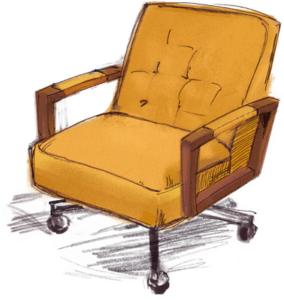
I recently got a chair for my studio (which I’ve sketched for you on the right). it sits in the opposite corner from my easel for guests and for staring at art. The springs are squeaky, and I’m resisting the urge to take up furniture reupholstering to fix it.
3. Clean up your work space at the end of each session.
Probably the most obvious, and one of the hardest things for me to do consistently- but it does help! Coming back to a space that you need to clean before you can start working is a good way to kill momentum and add dread to starting your next session. Cleaning up can be literal, washing brushes and palettes, putting away supplies. But I also mean digital cleanup: checking your files are named in a consistent formula and put away in the right folder. Make sure any new reference is grouped in a way that’s easy to find later.
Will I remember where I put the 10+ unlabeled reference photos of white shirts tomorrow? Probably. Will I remember three months from now? Most likely not, and I try to keep that in mind.
There’s also something inviting about a neat desk. It’s hard to resist making marks in a clean space, similar to the temptation to leave footprints in fresh snow (not that we get much of that in LA, but you get it).
This is what I’ve found helps me to bridge the gap between painting sessions, both long and short. If you’re also struggling to get back into a workflow you can try these out! Or if you’ve got your own tips then feel free to share in the comments. These habits were built through trial and error over time and continue to evolve, I’d love to hear what works for you.
When I’ve taken a break from creating it’s easy to spiral thinking of all the things I should be doing or all the progress I should have made by now. Consistency and discipline is about mindset, which is impacted by environment. Life will always fluctuate outside of our control, and we are constantly adjusting our priorities to to keep going. So I try to focus and ask myself: what part of my environment is under my control and how can I adjust it to support my goals?
There’s no one size fits all to a creative process. It needs to be tailored to work for each artist. For me, I’ve learned that I respond best to a process that creates from a place of desire rather than guilt.
Comments
-
-
Emil
Hi Lucy! A binder is such a good idea and you can keep the notes and lessons to keep in case you ever want to review. And you can add more to different sections if you find other lessons that fit the subject! Thank you for sharing the idea!
Yes, I started the log for larger pieces noticed it was useful for overarching projects too, like a series product designs series or more recently for me updating my website haha.
-
-
-


Lucy S.
“Create from a place of desire rather than guilt” is a wise refrain that can apply to a lot of different disciplines besides just art!
Also, I recently printed out a physical binder for art curriculum and lessons so I can try and self teach (since going to art school is not a current option, haha). I feel like the idea of a project log is a great thing to add to that for larger pieces to help keep up momentum. Thanks for sharing!